Director Mike Ryan – There’s Lots of Reasons To Put On A Play

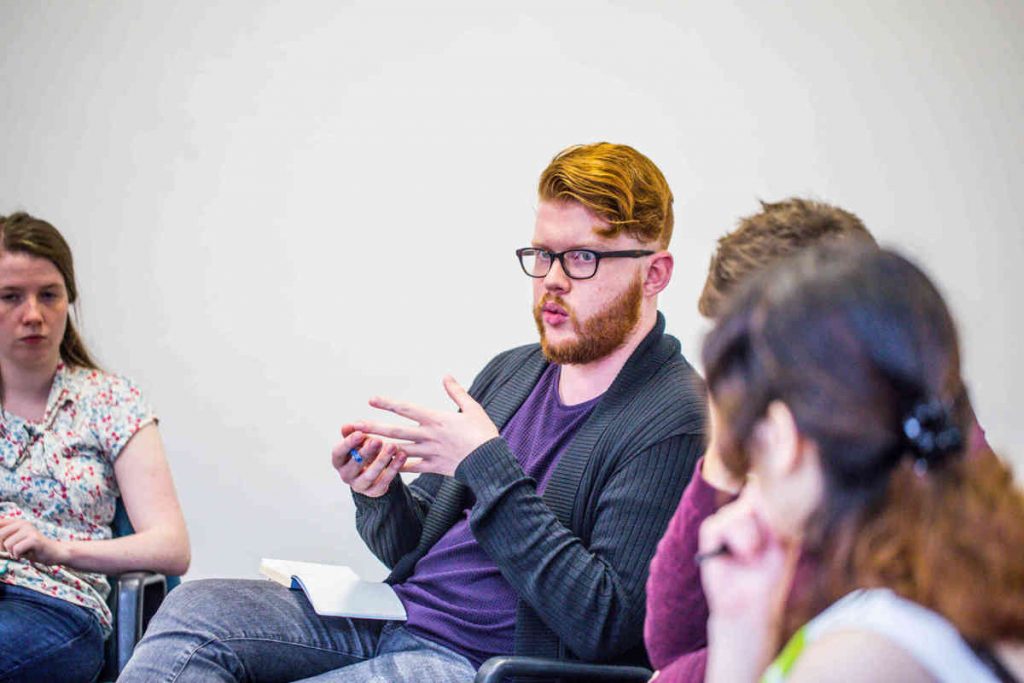
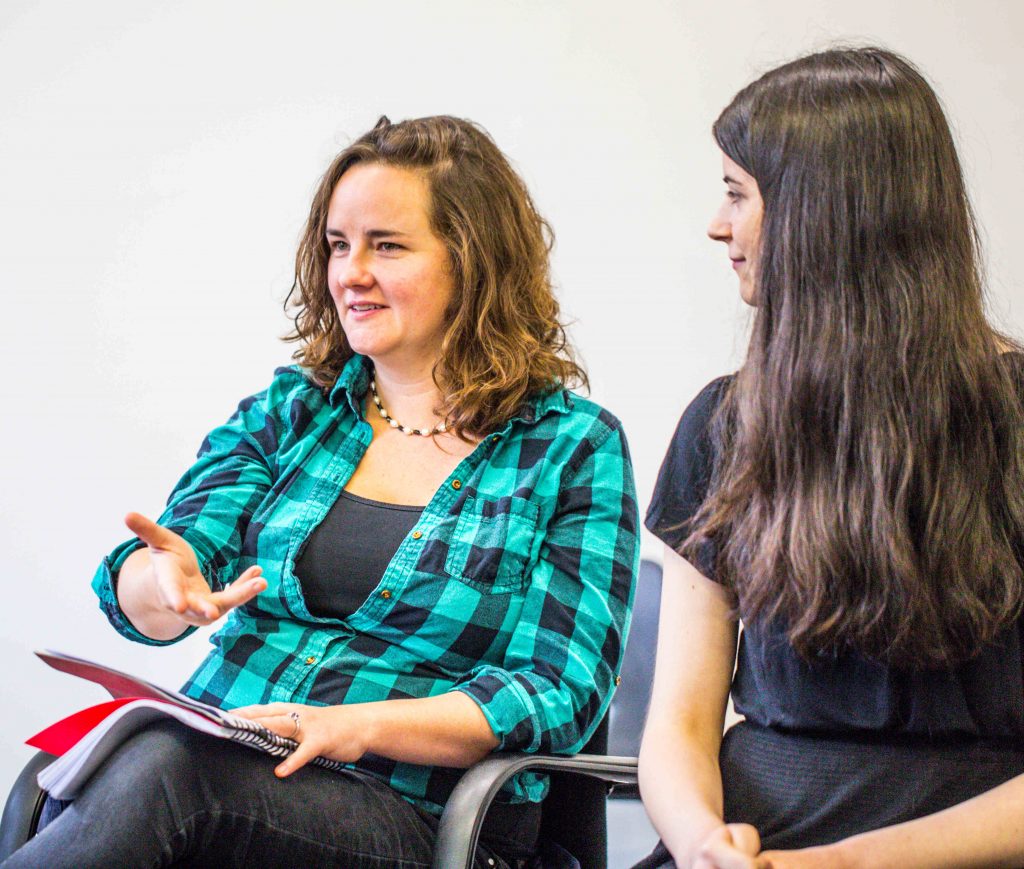
BelltableConnect Fishamble Mentoring Programme, photo by Ken Coleman

“Of course, there’s lots of reasons to put on a play”, Jim Culleton gleefully realised in answer to the question he had just asked of the directors present. Session number three of the Belltable:Connect: Fishamble Mentorship Programme offered plenty of discussion and discourse, as had the previous two instalments, but having thoroughly settled into the format by now, the assembled theatre creators wasted no time in getting to the nugget of this week’s topic.

It’s been a manic three months for all of the directors taking part, but after three sessions I’ve come to the conclusion that directors’ lives tend to be manic all the time. Thank god! I thought it was just me. I think that this realisation, more than anything else, is the great success of the programme so far. Being a director, you tend to lock yourself away in the little pocket universe of whatever play you’re directing. Being given the opportunity to discuss the highs, lows, and the general process of creating theatre as a director has been invaluable so far. Myself and Al, one of the other directors from Cork, joked early on that it was like a group counselling session for directors, and I don’t think that’s a bad thing.

Last February I set up my own theatre company called Ferocious Composure with some of the designers, actors and managers that I had worked with in UCC. The name came from the commentary for the 2014 All Ireland Gaelic Football Final. I can still hear Mícheál Ó Muircheartaigh’s voice as I sat in my car on the way back from helping with a puppet show in Meath. “The Kerry team have shown ferocious composure all year”. It’s how we in the company like to imagine ourselves. Ferocious yet composed, ready to pounce, and full of potential. I’ve come to realise over the past three sessions that, sadly, it’s not a trait unique to the individuals I recruited for my own endeavours. All eleven of my fellow directors have that same quality. I’m sure the playwrights group is the same. The theatre industry can be vicious and unforgiving at times, like a perpetual, harsh winter. I’ve come to the conclusion that if you set out to work in theatre in Ireland, you have to be driven, prolific and imaginative, while simultaneously maintaining your cool and standing your ground, otherwise you’ll be weeded out remorselessly before you even get a leaf out of the earth.

To push the metaphor even further into infuriating hyperbole, the “group counselling sessions,” in that case, serve as a welcome reminder of what awaits you if you do make it into the sunlight. More, like-minded individuals, ready to hear your woes, share their own experiences and offer help and advice in order to facilitate your own growth as a director/plant.

Working on my current production, “The Nun’s Wood” by Pat Kinevane, I’ve found the sessions incredibly helpful in two major ways. Firstly, the collective knowledge of the group is immense, especially with Jim thrown into the mix. I’ll often find myself rapidly scribbling notes for five or ten minutes at a time while listening to another director’s experience, or hearing the advice being offered to that director. Sometimes I’ll find myself offering an answer to somebody else’s question, only to realise that I’ve inadvertently solved one of my own problems. Secondly, (and to sheepishly bring things full circle), I’ve realised that I’m not alone in the madness of creating theatre. The problems I’m facing have been faced before. The thoughts and worries I’ve had have all been experienced already. Knowing that I have a safe space to which I can retreat once a month to say “Oh! That’s happened to you too?” gives me great confidence in my own ability and in my own choices.

It’s a mad auld industry we’ve chosen to plant ourselves in, and people get drawn into it from incredibly diverse backgrounds. I’m not sure if anybody really knows exactly why they put on a play. There’s lot’s of reasons to put on a play. There’s no one right answer to the question, but after three sessions I’m sure of one thing. Right answer or not, I’m not alone in being compelled to do it anyway.

Mike Ryan

“The Nuns Woodis running at the Granary theatre Cork from December 13-17. Tickets can be booked HERE.
I’m all out of bubblegum! – Pat Hynes on Belltable:Connect

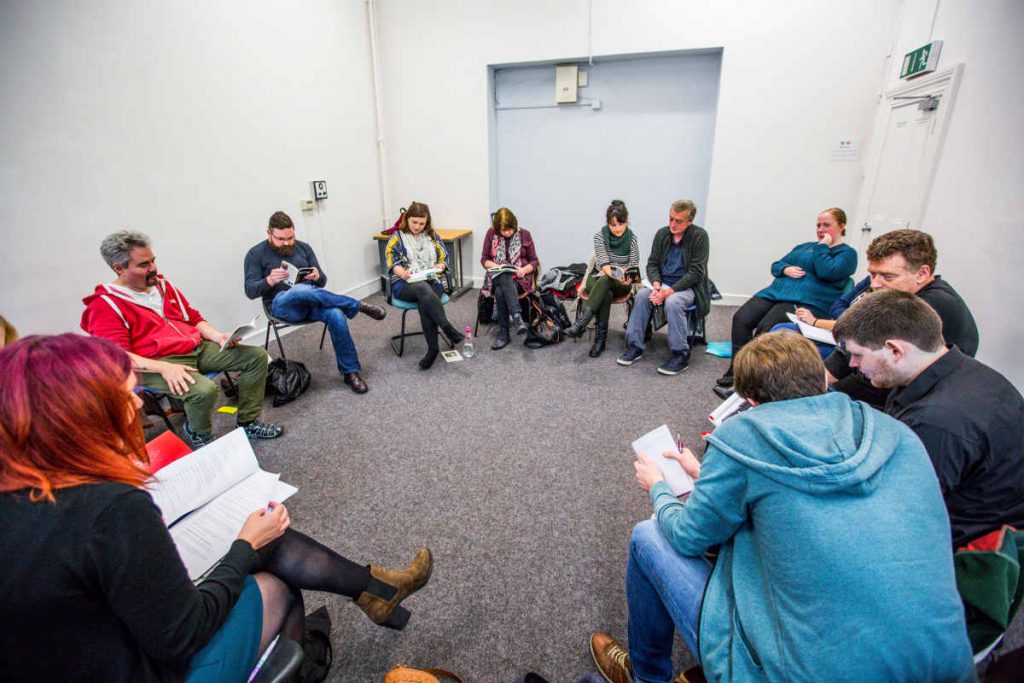
BelltableConnect Fishamble Mentoring Programme, photo by Ken Coleman

I’ve been into writing since I was a tot. Myself and my pal Pony were always half-trying to outdo each other with tales of derring-do, entertaining ourselves by putting a spin on the dreary “English Composition” exercises we were doled out in National School (i.e. My Dream, or My First DOT DOT DOT). We eventually started to write daft stories without the aid of a prompt, creating whole worlds for our own entertainment. Our stories were peppered with grisly scenes of bloody death, like Rambo on steroids (I suppose it’s no surprise as we both saw First Blood when we were 7). Often the protagonist was alone and found themselves in the midst of a jungle, or a dense forest with jeeploads of sweaty, grimy men emerging from the undergrowth on all sides, bearing ill-will against our hero, mostly just for existing. There was no need to reveal anything about these guys’ inner turmoil; to provide a back-story or explain further would be to obfuscate, we just wanted to get straight into the action. We didn’t get bogged down in the detail, we took our joy in seeing them get bogged down in the muck and jungle.

Flash-forward three decades, and I’m still at it: still producing short stories, but mostly plays and screenplays. They mightn’t be as bloody as the first, but there are still liberal doses of horror and violence to be found in there. As well as telling stories, I’m selling them – flogging books in our bookshop, Scéal Eile Books in Ennis by day, but by night (and on weekends!) I’m writing away.

One of my plays was short-listed for the Eamonn Keane Playwriting Award (Listowel Writers’ Week) earlier this year, and others made the short-list for RTÉ’s PJ O’Connor Award, and the Bruntwood Playwriting Award. I’ve been to the Edinburgh Fringe Festival twice in the last decade, once with a company play, and the last time with my own offering Sparks; a one-man show with Darren Killeen, brought over by our own Scéal Eile Productions, set-up by myself and my wife Éibhleann. We very much follow the ethos “Keep on keeping on”. I’m enjoying being part of the Belltable:Connect /Fishamble Mentoring Programme. The best part about this mentorship so far is being given prompts by Gavin Kostick (which are very useful and in stark contrast to my past experience of writing prompts and workshop environments), and being led creatively towards the production of new ideas.

It’s very easy to become lost in a world of ideas when you are working alone outside a group, and sometimes you just need a kick up the arse and someone to tell you to just write the fecking thing and stop procrastinating! Gavin hasn’t given anyone a kick in the arse yet but once he’s over his tennis injury… well let’s hope he’s not out of bubblegum! I’m working on a new play, which will develop throughout this next year as part of the mentorship, aided by the finest selection of biscuits to be found in any theatre, anywhere. Thanks, Belltable!

Director Martin Kenny: ‘what price could you possibly put on the idea of change?’

BelltableConnect Fishamble Mentoring Programme, photo by Ken Coleman

“I have squandered the years the Lord God gave to my youth
In attempting impossible things, deeming them alone worth the toil”
– “The Fool” by Pádraig Pearse

For this second session of the Belltable:Connect programme in conjunction with Fishamble: The New Play Company, the early focus was placed on Beckett’s seminal text, Not I, as well as Theatre Lovett’s recent production of A Feast of Bones, two plays chosen by Rebecca Feely and Mollie Molumby as their respective favourite theatrical texts. Rebecca spoke passionately about Not I as a text and its place within Beckett’s body of work, nestling itself within his trope of dehumanizing the human body and consciousness in an attempt to excavate the essential experience of what it is to “exist”. Mollie prefaced A Feast for Bones by speaking on another of her favourite plays, Every Brilliant Thing by Duncan Macmillan, and how the author so effectively speaks about issues surrounding mental health within the context of family theatre. This led on to the discussion of Theatre Lovett’s production and how the company creates dynamic, absorbing and challenging works for audiences of all ages and how this ability to communicate across age and experience gaps highlights the strength of the company’s work and the themes it engages with. The discussion of both works was characterized by sincere passion, both speakers eager to share what makes these plays and production so pertinent to them and their development as directors. Mollie concluded speaking about TYA (Theatre for Young Audiences) in highlighting its lack of funding in Ireland and widened the discussion to ask the group if they thought there were any other areas of theatre which were underfunded in Ireland.

This question was met with flitting eyes and wry smiles until the common consensus was shouted simultaneously: “ALL OF IT!”.

Although we all laughed and acknowledged the hardship of funding our work in theatre, the mention of it in the room was quite palpable – a sense of worry trickled in. Funding was raised further in the director’s roundtable on current projects in development, and it struck me how quickly the passion of speaking about theatre in the first half of the session was tempered by discussions of money and funding.

I quote Pádraig Pearse above for this very reason. The quote shows how the work of art and theatre is what we do it for, not for financial gain or recognition, and allowing money to constrain our ideas in contradictory to our work. Theatre and the arts are not a means, they are the end. The Fool is featured in an upcoming production I am directing and acting in with the Arts in Action programme in NUIG this month. The production is called  Love, Loss, Freedom and it gathers together poetry from 1916 as well as music of the era to reflect the ideas of the Rising and to articulate what gave rise to it in the first place. Being surrounded by these revolutionary ideas has instilled me with a certain renewed faith in doing theatre and establishing a career in the arts. The ideas championed in war poetry of the era not only reflected the ideas of the time, it helped to bolster and strengthen them. Granted the outcome of those ideas was bloodshed and death, but it serves to show the strength of art and how its echoes resound enough to influence action. Although a necessary evil of working in theatre (and practically throughout life in general), money should not allow us to deny ourselves the chance to pursue what is we truly want to do.

And this is not an unrealistic world view, or a naive one. Or a “millenial” one for that matter. The idea that the arts exist beyond monetary value lead many to view it as superfluous – what good does it provide economically in a capitalist society? But what price could you possibly put on the idea of change? Granted, each and every piece of theatre may not have a wide reaching effect itself, but in the way similar shows with similar themes communicate with one another to begin to affect change, this is the real strength of theatre and the arts.

In doing the Belltable:Connect programme, we as directors and playwrights come together to share this passion for theatre and the arts and for a brief period get to consider the work itself without considering the extenuating circumstances of it. This is not to say we live in a lovely little theatrical bubble. Rather there is a safe space for us to share creativity and therefore bolster ourselves for when the time does come to seek funding. It allows for a renewed sense of faith in our ideas and in ourselves. These “impossible things” are indeed themselves, “worth the toil” and it’s great to have the opportunity to be reminded of that in being part of this programme.

First Playwright Session of Mentoring Programme

BelltableConnect Fishamble Mentoring Programme, photo by Ken Coleman

Niall Carmody is a playwright originally from Limerick who now lives and works in Galway. He is a recent graduate of NUIG and is currently working on a set of original plays. Here he writes about the first session of Belltable:Connect Fishamble Mentoring Programme for Playwrights and Directors:

‘The first session of our Belltable:Connect programme filled me with the same nervous excitement of the first day of school. Arriving at the Belltable in Limerick City I met the other participants. Over tea and coffee we introduced ourselves and talked about expectations and hopes for the programme. An overview of the history of the Belltable:Connect programme was given to the group by Marketa Dowling, the Belltable Programme Manager. We were introduced to Gavin Kostick and Jim Culleton of Fishamble and split into our appropriate groups; Directors with Jim, Playwrights with Gavin. We made our way to the playwrights room and immediately got down to business. Gavin explained each session would be composed of three parts. Firstly we would discuss the plays we would be given to read for each session. Secondly we would discuss our task to be submitted to Gavin for the upcoming month (covering themes surrounding the plays discussed in the class). Thirdly each week four writers would present an idea they have to the group for feedback. These ideas could come in the shape of a script or presentation or simply a brain storming session.

For our first session we discussed the plays Woman and the Scarecrow by Marina Carr and Swing by Steve Blount, Peter Daly, Gavin Kostick and Janet Moran. The two plays chosen contrast greatly as Swing is a devised piece full of movement and dance whereas Woman and the Scarecrow is a stiller play with emphasis on dialogue and conversation. The two plays highlighted contrasting styles of writing and theatre making as one play is a solo work while the other is devised by four different artists. Next we examined the opening of Antigone which highlights the epic elements of Greek Tragedy. The contrast between the opening of Antigone and Swing lead to our first task for the next session. We are each to write an opening to a play and send them to Gavin of discussion in our next session. Four members of the group also put themselves forward to present an individual idea of the next session. From the first session I can see the programme being an interesting ten months full of writing, discussion, and collaboration.’

Start of Mentoring Programme for Playwrights and Directors

Belltable:Connect Fishamble Mentoring Programme-photo by Ken Coleman
Belltable:Connect Fishamble Mentoring Programme – photo by Ken Coleman

On September 24th, 2016, we welcomed Jim Culleton and Gavin Kostick of Fishamble: The New Play Company to Belltable:Connect. Jim and Gavin lead the 10-month Mentoring Programme for Playwrights and Directors. Limerick-based director Ann Blake here shares her experience of the first session:

‘At the early time of 10am on Saturday September 24th, the Belltable foyer was unusually abuzz. Mentee directors and playwrights gathered, were furnished with coffee and pastries – quite welcome to those who had to be up early to travel I’d imagine – and got ready to start the mentorship venture, Belltable:Connect in association with Fishamble Theatre Company. Having been welcomed by Marketa Dowling of the Belltable, we split into our respective disciplines, directors with Jim Culleton and playwrights with Gavin Kostick and headed upstairs to the Arts Hub.

In the directors’ room I saw faces I recognised amongst the many I didn’t. It became clear, as each person was introduced, that this was a diverse group of directors of varying ages, backgrounds and hometowns. We got to know each other, explored ideas of what a play actually was and soon found ourselves at our coffee break. That funny ‘first day at school’ feeling where you want to get to know the people you don’t know took hold. Being Ireland and the very small community that is Irish theatre, it wasn’t surprising to find I had friends in common with a quite a few of the participants.

By the end of the day some of us had had an opportunity to share concerns about projects we were working on and tap into the hive mind available to us as well as offer our thoughts on work others were looking for ideas and/or support around. As I’m starting directing a show this week, this was good timing for me and particularly helpful.

In a lovely turn of events I went online yesterday and saw that one of the projects discussed, Halflight, won the First Fortnight Award in The Tiger Dublin Fringe – congrats Molly!’

Ann is a theatre director and lives and works in Limerick. Her most recent work is The Crucible with BA in Contemporary Applied Theatre in Mary Immaculate College, she is currently working on Cars Production with UL Drama Society.